Our order book for 2026 is officially closed! We are now accepting orders for 2027 onwards.
Solid timber is a natural material. Unlike manufactured boards such as MDF or plywood, every piece of timber is unique and continues to respond to the environment long after it has been cut, dried, and crafted into furniture.
One of the defining characteristics of wood is its ability to absorb and release moisture from the surrounding air. As humidity levels rise and fall throughout the year, the moisture content within the timber changes accordingly. This natural process causes wood to expand and contract, making a certain amount of movement completely normal and expected.
At Scotsmen Woodwork & Joinery, we carefully consider these characteristics when designing and manufacturing our furniture. Understanding how timber behaves helps explain why small changes in appearance or dimensions are a natural part of owning handcrafted solid wood furniture.

Every piece of timber contains moisture within its structure. During the drying process, most of this moisture is removed until the timber reaches a level suitable for furniture manufacturing. However, timber never becomes completely moisture-free.
Instead, it continually adjusts to the environment around it. When the surrounding air becomes more humid, the timber absorbs moisture and expands. When the air becomes drier, it releases moisture and contracts.
Because indoor humidity changes throughout the seasons, wood is constantly seeking balance with its surroundings. This means that movement is an ongoing characteristic of solid timber throughout its lifetime.
Several environmental factors influence how timber behaves.
These can include:
Furniture placed in air-conditioned homes may behave differently from furniture placed in naturally ventilated spaces. Likewise, moving furniture between different climates or regions may result in noticeable changes as the timber adjusts to its new environment.
Wood does not expand and contract equally in every direction. Movement along the length of the grain is extremely small and generally insignificant. Most movement occurs across the width of the board. Depending on how the timber was sawn from the log, some boards are naturally more stable than others.
This directional movement is a normal property of timber and cannot be prevented. Instead, quality furniture is designed to accommodate these natural dimensional changes without compromising its structural integrity.
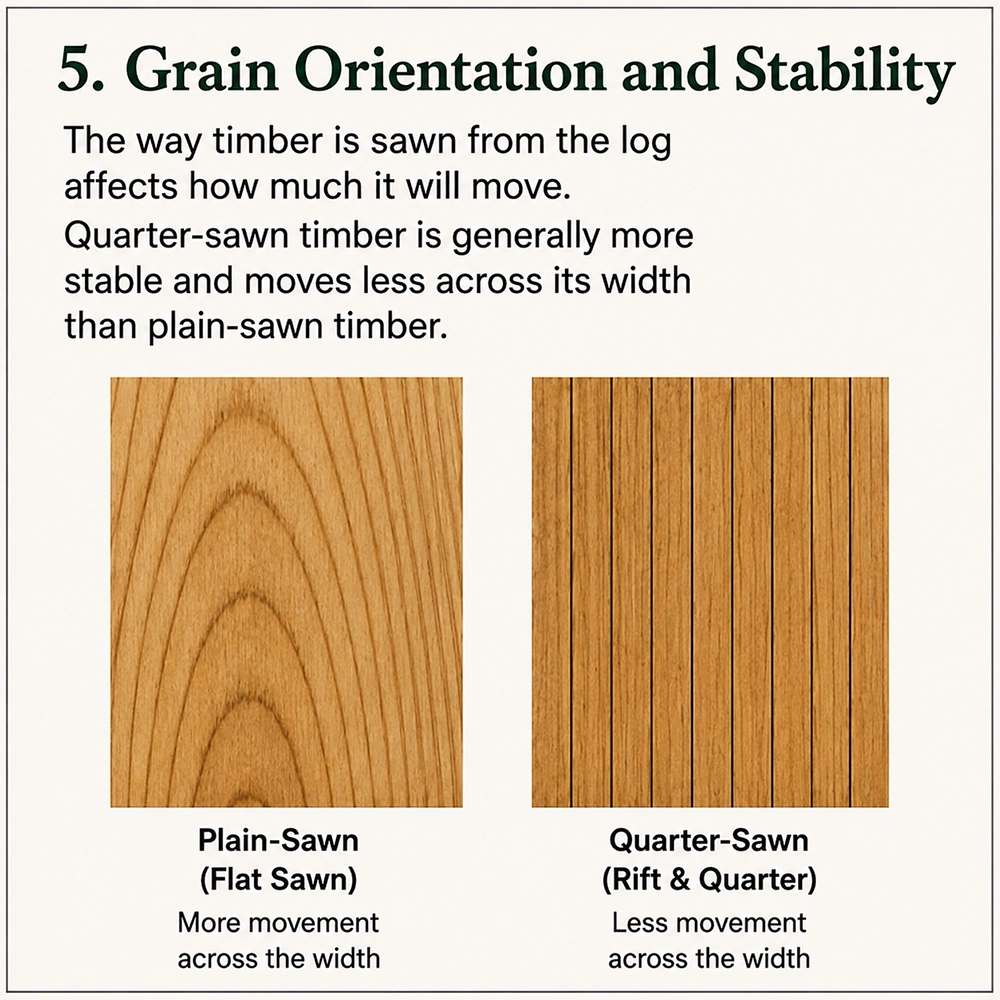
The orientation of the grain has a significant effect on the stability of timber. Quarter-sawn timber generally experiences less movement across its width than plain-sawn timber and is often preferred where maximum stability is desired. Plain-sawn timber displays attractive grain patterns but is naturally more likely to expand, contract, or cup as environmental conditions change. Neither method is inherently defective, each simply has different characteristics that must be considered during manufacturing.
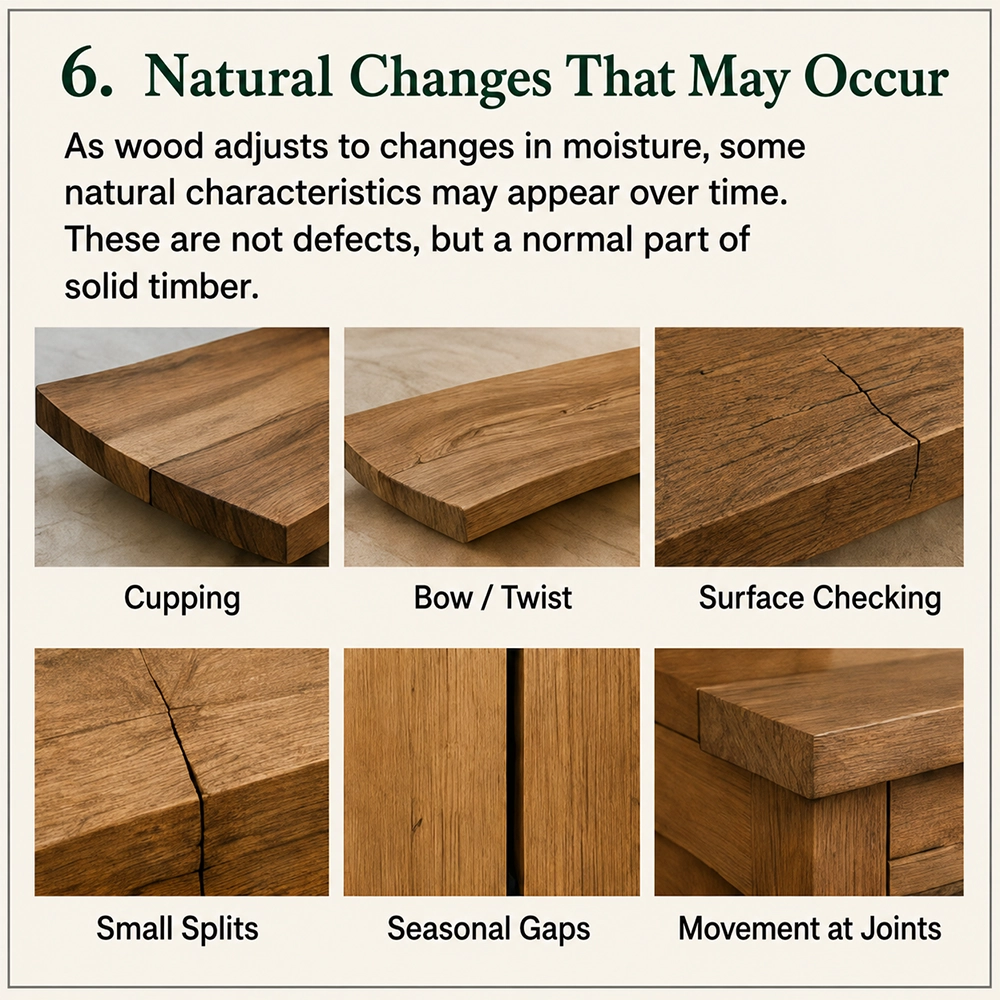
As solid timber responds to changing moisture levels, various natural characteristics may develop over time.
These can include:
These characteristics are a normal result of the timber adjusting to its environment and should not be considered manufacturing defects.
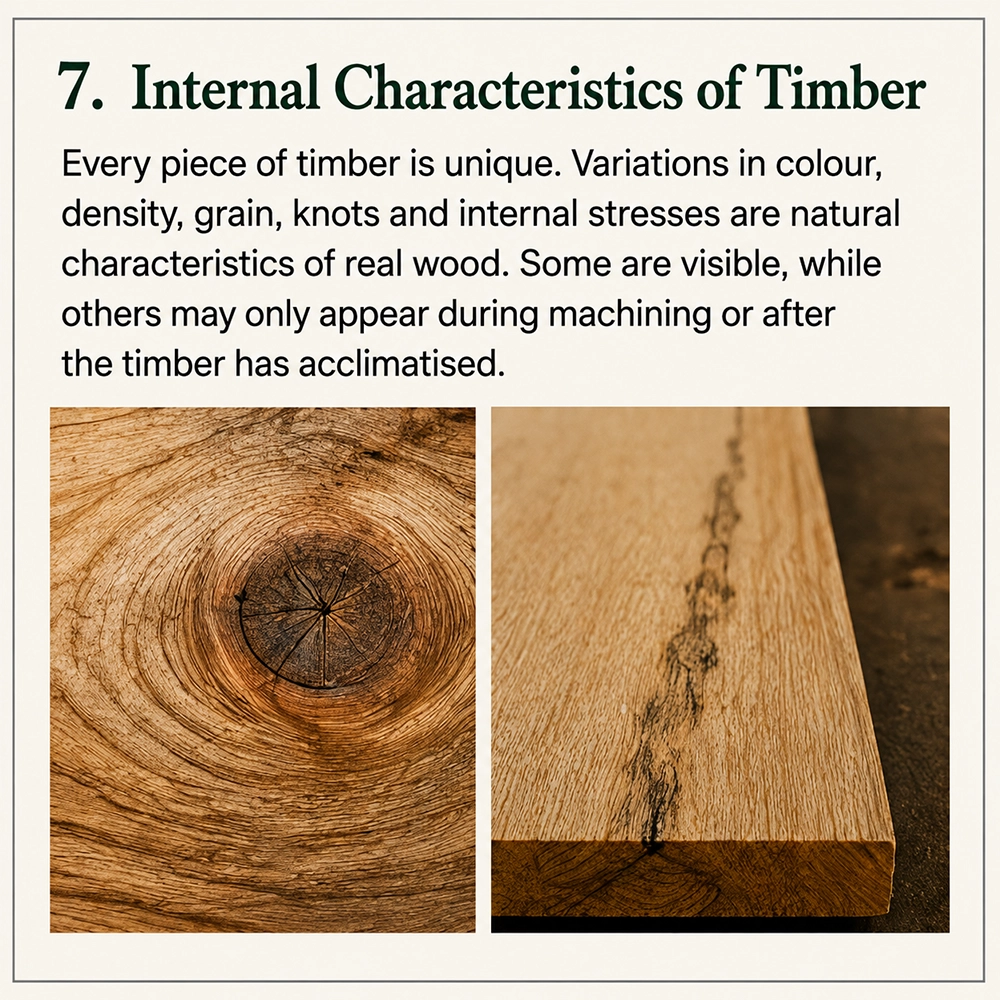
Because timber is a natural product, every board is unique.
Even within the same species, timber may vary in:
Some characteristics are visible before manufacturing, while others may only become apparent during machining or after the timber has acclimatised to its final environment. These natural variations are part of the beauty and individuality of solid wood furniture.
A well-built piece of solid timber furniture is designed with wood movement in mind. Rather than attempting to prevent movement entirely (which is impossible), we use proven construction methods that allow timber to move naturally while maintaining strength and durability.
This may include:
These techniques help minimise stress within the timber while preserving the longevity of the furniture.